
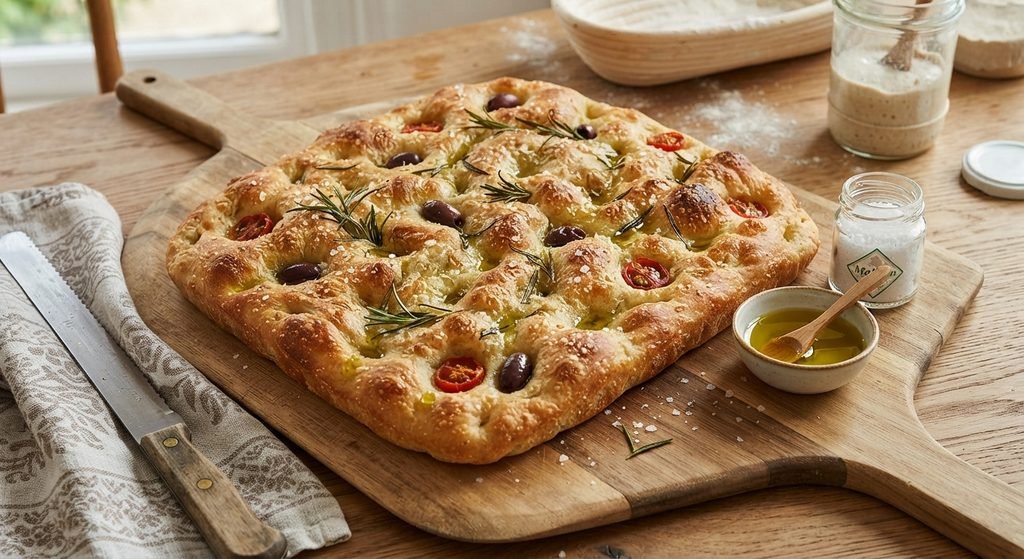
If you’ve been looking for a sourdough focaccia recipe that actually works in a home kitchen, this is it. The crust is crisp and golden on the bottom, the top is dimpled and glossy with olive oil, and the inside is soft, chewy and full of irregular holes. It also has that gentle tang only a sourdough starter can give.
The best part is that it needs almost no work. There’s no kneading and no fancy equipment. You stretch and fold the dough a few times, let the fridge do the heavy lifting overnight, and bake it the next day. If you can stir a bowl of dough, you can make this.
Quick recipe snapshot
| Prep time | 20 minutes active |
| Total time | 18 to 24 hours (mostly hands-off) |
| Bake time | 22 to 28 minutes |
| Yield | One 9×13 inch pan, 12 squares |
| Difficulty | Easy |
Why You’ll Love This Sourdough Focaccia
- No kneading. A few gentle stretch and folds build all the structure you need.
- No commercial yeast. Your active sourdough starter does all the leavening.
- Flexible timing. The overnight cold ferment fits around real life and deepens the flavor.
- Great for discard-minded bakers. It uses a modest 100g of starter, so it’s a good way to put a healthy, bubbly starter to work.
- Endlessly adaptable. Keep it classic with flaky salt and rosemary, or load it with tomatoes, olives or garlic.
Ingredients
For the dough
- 500g (about 4 cups) bread flour. You can use all-purpose, but bread flour gives a chewier, airier crumb.
- 400g (1 3/4 cups) lukewarm water, about 80% hydration
- 100g (1/2 cup) active, bubbly sourdough starter at 100% hydration (equal parts flour and water by weight)
- 10g (2 teaspoons) fine sea salt
- 30g (2 tablespoons) extra virgin olive oil, for the dough
For the pan and topping
- 40g (3 tablespoons) extra virgin olive oil, for the pan
- Flaky sea salt, such as Maldon
- Fresh rosemary leaves (optional)
- Extra olive oil for drizzling
A note on measuring: Please use a kitchen scale if you can. Focaccia is a high-hydration dough, and a few extra spoonfuls of flour can turn a loose, airy dough into a dense one.
Equipment
- Large mixing bowl
- Kitchen scale
- 9×13 inch (23×33 cm) metal or glass baking pan. A dark metal pan gives the crispest bottom.
- Silicone spatula or damp hands
- Plastic wrap or a reusable cover
How to Make Sourdough Focaccia, Step by Step
Step 1: Check that your starter is ready
Feed your starter 4 to 8 hours before mixing. It should have doubled, look bubbly and domed on top, and smell pleasantly tangy rather than sharp. A simple test is to drop a spoonful into water. If it floats, it’s ready.
Step 2: Mix the dough (5 minutes)
In a large bowl, whisk the lukewarm water and starter together until the starter mostly dissolves. Add the flour, salt and 30g of olive oil. Mix with a spatula or wet hands until there are no dry patches. The dough will look shaggy and very sticky. That’s exactly right.
Cover the bowl and let it rest for 30 minutes. This rest, called an autolyse, lets the flour hydrate and makes the dough easier to handle.
Step 3: Stretch and fold (4 rounds, 30 minutes apart)
With wet hands, grab one edge of the dough, stretch it up gently, and fold it over the center. Turn the bowl a quarter turn and repeat until you’ve done all four sides. That’s one round.
Cover the bowl and wait 30 minutes. Repeat for a total of four rounds. You’ll feel the dough go from slack and sticky to smooth, elastic and billowy.
Step 4: Bulk fermentation (2 to 4 hours)
After the last fold, leave the dough covered at room temperature, ideally 72 to 78°F (22 to 26°C). In a warm kitchen, bulk fermentation takes about 3 to 4 hours total. In a cool one, it can take 5 or more.
You’re looking for the dough to grow by about 50 to 75%, with bubbles visible around the edges and a jiggly, airy feel. Go by the dough rather than the clock.
Step 5: Pan it up
Pour 40g of olive oil into your baking pan and spread it across the bottom and up the sides. Don’t be shy. This oil is what fries the bottom crust into that crisp, golden layer.
Scrape the dough into the pan, turn it once to coat it in oil, and gently stretch it toward the corners. If it springs back, wait 10 minutes and try again. The dough doesn’t need to reach the edges yet.
Step 6: Cold ferment overnight (12 to 24 hours)
Cover the pan tightly and refrigerate for 12 to 24 hours. This slow, cold rise develops complex flavor, creates bigger bubbles and makes the dough easier to shape.
Step 7: Warm up and dimple
Take the pan out of the fridge and leave it on the counter for 1 to 2 hours, until the dough has relaxed, filled the pan and looks puffy and bubbly. Near the end, preheat your oven to 450°F (230°C).
Drizzle the top with olive oil. Oil your fingertips and press straight down into the dough, all the way to the bottom of the pan, to make deep dimples across the whole surface. Sprinkle with flaky salt and rosemary.
Step 8: Bake
Bake on the middle rack for 22 to 28 minutes, until the top is deep golden and the edges are crisp. Lift a corner with a spatula to check that the bottom is browned too.
Step 9: Cool
Brush with a little extra olive oil while it’s hot. Let it rest in the pan for 5 minutes, then transfer it to a wire rack. Cooling on a rack keeps the bottom crisp instead of steamy. Slice and eat while it’s still warm.
Sourdough Focaccia Timeline
| Time | What you’re doing |
|---|---|
| 8:00 AM | Feed starter |
| 1:00 PM | Mix dough, rest 30 minutes |
| 1:30 to 3:30 PM | Four rounds of stretch and folds |
| 3:30 to 6:00 PM | Finish bulk fermentation |
| 6:00 PM | Oil pan, transfer dough, refrigerate |
| Next day, 4:30 PM | Take out of fridge, warm up |
| 6:00 PM | Dimple, top and bake |
Shift this to suit your day. If you’d rather bake in the morning, mix in the afternoon and let the dough cold ferment for about 16 hours.
Tips for the Best Sourdough Focaccia
Use a strong, active starter. A sluggish starter is the most common reason focaccia turns out dense. If yours isn’t doubling within 4 to 6 hours of feeding, give it another feeding or two before baking.
Don’t skimp on olive oil. Good extra virgin olive oil adds flavor as well as moisture, and the oil in the pan is what crisps the crust.
Keep your hands wet. A bowl of water next to you makes handling this sticky dough much easier.
Dimple deeply. Press all the way down. Shallow dimples puff back up and lose the classic look.
Watch the dough, not the clock. Temperature changes everything. A warm kitchen speeds up fermentation, and a cool one slows it down.
Don’t deflate it. Handle the dough gently after the overnight rise so you keep those gas bubbles.
Troubleshooting
My focaccia is dense and bready. The dough was probably under-fermented, or the starter wasn’t strong enough. Let the dough get puffier and more jiggly before baking next time.
It spread flat and has no rise. It may have over-fermented. Shorten the bulk fermentation or the room temperature rest after the fridge.
The bottom is pale and soft. Use a dark metal pan and more oil, and bake on the lower rack for the last 5 minutes.
The crust is too hard. Bake a little shorter or lower the temperature slightly. Brushing with olive oil as soon as it comes out helps too.
The dough tears when I stretch it. It needs to rest. Wait 10 to 15 minutes and try again.
Variations
- Rosemary and sea salt: The classic. Use plenty of flaky salt.
- Cherry tomato and garlic: Press halved cherry tomatoes and thinly sliced garlic into the dimples before baking.
- Olive and thyme: Add pitted Kalamata or Castelvetrano olives and fresh thyme.
- Parmesan and black pepper: Sprinkle on grated Parmesan during the last 5 minutes of baking.
- Garden focaccia: Decorate with thin slices of bell pepper, red onion and fresh herbs to make a picture. It’s fun with kids.
- Whole wheat blend: Swap 100g of the bread flour for whole wheat for a nuttier flavor.
- Same-day method: Skip the fridge. After bulk fermentation, pan the dough, let it rise 1 to 2 hours until puffy, then dimple and bake. It will have a milder flavor but still taste great.
Storage and Reheating
- Room temperature: Wrap in a clean towel or store in a bread bag for up to 2 days.
- Freezer: Slice, wrap tightly and freeze for up to 3 months.
- Reheat: Warm slices in a 350°F (175°C) oven for 8 to 10 minutes to bring back the crisp crust.
Ways to Serve Sourdough Focaccia
Sourdough focaccia is great on its own, but it also makes excellent sandwiches (try mozzarella, tomato and basil), and it’s perfect for dipping in soup or a bowl of olive oil and balsamic vinegar. Serve it alongside pasta, a big salad or a board of cheese and cured meats.
Frequently Asked Questions
Can I make sourdough focaccia without an overnight rest?
Yes. The cold ferment is optional. Without it, let the dough rise in the pan for 1 to 2 hours at room temperature before dimpling and baking. The flavor will be milder.
Can I use sourdough discard?
Fully active starter gives the best rise. Unfed discard will make a denser, tangier focaccia, though it can work if you add a pinch of instant yeast (about 1/4 teaspoon).
What kind of flour is best?
Bread flour, thanks to its higher protein content, gives the chewiest, airiest result. All-purpose flour works but produces a slightly softer, less open crumb.
Why is my dough so sticky?
High hydration is what makes focaccia airy and open. Wet your hands and the stickiness becomes manageable. Resist adding extra flour.
Can I bake it in a cast iron skillet?
Absolutely. A preheated, well-oiled cast iron skillet makes an exceptionally crisp bottom crust. Use a 10 to 12 inch skillet and bake a half batch.
What pan size should I use?
A 9×13 inch pan is ideal. A smaller pan gives a taller, fluffier focaccia that may need a few more minutes in the oven. A larger pan gives a thinner, crispier one.
How do I know when my focaccia is done?
The top should be deeply golden, the edges pulling away and crisp, and the bottom browned when you lift a corner. An internal temperature of about 205°F (96°C) is a good check.
Can I double the recipe?
Yes. Double everything and use a half-sheet pan, or make two 9×13 pans.
Final Thoughts
Homemade sourdough focaccia is one of the most rewarding breads you can make. It’s forgiving and mostly hands-off, and it looks impressive on the table. Once you’ve made it a couple of times, you’ll start tweaking the toppings, hydration and timing to suit your own kitchen.
If you try this sourdough focaccia recipe, I’d love to hear how it turned out. Leave a comment below with your tweaks and toppings.
Suggested SEO extras
- Primary keyword: sourdough focaccia recipe
- Secondary keywords: overnight sourdough focaccia, easy sourdough focaccia, no-knead sourdough focaccia, sourdough focaccia bread, focaccia with sourdough starter
- Suggested image alt text: “Golden sourdough focaccia with rosemary and flaky sea salt in a baking pan”
- Internal link ideas: how to make a sourdough starter, sourdough discard recipes, best olive oil for baking